Mayan Food
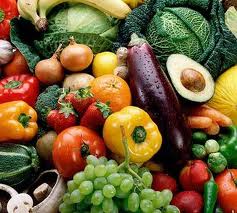
A Mayan's daily diet was 75% maize. Ironically maize was also their main crop. They also ate other things, like: beans, squash, roots turtles, armadillo, fresh water fish, deer, dog, turkey, and honey. Besides Corn and beans, they cultivated mandioc, jícama, sweet potatoes (Ipomea batata), guavas, and tomatoes also the Maya are the sources of such familiar foods and seasonings as vanilla beans, chili peppers and chocolate. Most of the secondary food crops of the Central area were fruits such as the papaya, hog plums, nance plums, guavas (pasah) and the avocado pear.
Mayan Women
Mayans were amazing weavers. They made very intricate designs. But, it was mainly the women the weave. The women would stay at home and weave, cook, do laundry, and harvest crops. The women were very important people in their tribe. There clothing would often consist of a huipil, a skirt, and a belt.Although women were important in aspects other than those associated with the ability to bear children, the latter remained a very important part of their lives. The mythology and power associated with the ability to create was one which men tried to emulate. Aside from political involvement, women also participated in the Maya food economy. Ancient Maya women had an important role in society: beyond just propagating culture through the bearing and raising of children, Maya women involved themselves in economic, governmental and farming activities.

Daily Activities
School:
Most children weren't lucky enough to go to school. Only 10% of kids did, and they were the rich ones. There was one preist that would teach math, science, astronomy, and language.Games:
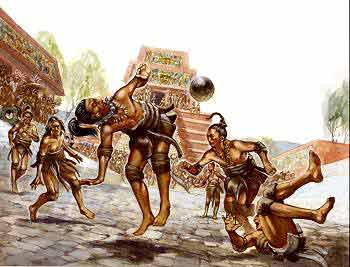
The Mayans were wonderful sportsmen and build huge ball courts to play their games. The Great Ball court of Chichén Itzá is 545 feet long and 225 feet wide overall. It has no vault, no discontinuity between the walls and is totally open to the sky.
Each end has a raised "temple" area. A whisper from end can be heard clearly at the other end 500 feet away and through the length and breath of the court. The sound waves are unaffected by wind direction or time of day/night. Archaeologists engaged in the reconstruction noted that the sound transmission became stronger and clearer as they proceeded.
Legends say that the the winning captain would present his head to the losing capitan, who then decapitates him. While this may seem a strange reward, the Mayans believed this to be the ultimate honor.The winning captian getting a direct ticket to heaven instead of going through the 13 steps that the Mayan's believed they had to go through in order to reach heaven..
The sacred Ball Court was the site of a brutal Mayan sport. The field, approximately the size of a football field, is bordered by two imposing walls 26 feet tall. Seven combatants on each team tried to get a small rubber ball to go through a small stone hoop 23 feet above the ground supposedly without using their hands or feet to touch the ball. Virtually all descriptions of the native Mexican ballgames stress that hands were not allowed to touch the ball. Yet two 8th century Maya sculptures and several Peten Maya vases show players with their hands on the ball.It is believed that the losers of this game were often sacraficed to the Gods. These Mayan games predate the olympics by about 500 years!
The games played in the ball court were sometimes played to the death.
The Maya central city area was built for religous reasons. Almost every Mayan city had a ball court to play the ball game Pok-A-Tok. Pok-A-Tok games were often played as parts of religous ceremonies. Besides this large court, Chichen-Itza has 22 other courts, testimony to the importance of this (blood) sport.
Serious injury could be inflicted on a player with the hard ball which was mainly struck with the elbows, knees or hips, but was not to be hit with the hands, feet or calves. Players were known to throw themselves on the ground to hit the ball properly. The full impact of the ball was in this case absorbed by the body. Participants wore equipment for protection, including chin pieces and half masks for cheeks, hard leather gloves, quilted cotton elbow pads, knee pads, belts or yokes made of leather or basketry for the waist a protruding palmate stone, and a leather apron.
Mayan ball game
Mayan Men:
For men their main things were to farm and hunt. They were very important in the tribe. Their clothes would change over the years. Men would participate in the act of bloodletting their own genitals to create something new from their blood. Instead of giving birth to life they would give birth to new eras through the symbolic gesture of menstration. This act was highly ritualized; the objects used to pierce the skin were “ stingray spines, obsidian blades, or other sharp instruments.” The blood was allowed to drip on cloth, which was then burned.Chores:
Mayan children grew up fast so they learned their parents jobs. The girls would spend the day learn to cook and sow and the boys would go out with the men and hunt.Religion
Mayan were very religiuos. The believed in gods, including: the sun God , the God of the North, God of death, God of corn, God of sacrificing, ect.. To supporrt the Gods and keep them happy they would have rituals were they would sacrifice people. If you got sacrificed it was a great honor beacuse you would go straight to heaven. They would also build temples to worship them in.
Calenders
The Maya practiced a form of divination that centered on their elaborate calendar system and extensive knowledge of astronomy. It was the job of the priests to discern lucky days from unlucky ones, and advising the rulers on the best days to plant, harvest, wage war, etc. They were especially interested in the movements of the planet Venus — the Maya rulers scheduled wars to coordinate with its rise in the heavens.

A Mayan calendar.
|
The Mayan calendar was very advanced, and consisted of a solar year of 365 days. It was divided into 18 months of 20 days each, followed by a five-day period that was highly unlucky. There was also a 260-day sacred year (tzolkin), divided into days named by the combination of 13 numbers and 20 names.
For longer periods, the Maya identified an elaborate system of periods and cycles of various lengths. In ascending order, these were: kin (day); uinal (20 days); tun (18 uinals/360 days); katun (20 tuns/7,200 days); baktunbaktun (20 katuns/144,000 days), and so on, with the highest cycle being the alautun (23,040,000,000 days).
These units were used in the Maya Long Count, which calculated the time elapsed from a zero date set at 3114 BC. In the Postclassical Period, the method of notation was somewhat simplified, and the Long Count katuns end with the name Ahau (Lord), combined with one of 13 numerals; and their names form a Katun Round of 13 katuns.
The Mayan calender goes on a cycle but, the Mayans stopped making it at the year 2012. Even though the Mayan calender goes on a cycle some people believe that the world will end in 2012.
